

Step into the 1920s with Rolling Heights, a city-building game set during the rise of North America's first skyscrapers. You play as a construction company trying to gain influence in a growing city.
Rolling Heights is built around a meeple-tossing mechanic that starts every turn. Your meeples' final position determines what actions are available to you, from grabbing new building blueprints to upgrading your construction abilities. Each completed building earns you rewards that help you build faster and bigger.
Everyone is competing for the best blueprints and the most valuable spots in the city. As the game progresses, the board fills up with buildings and grows more complex.
Points are earned through buildings and objectives. Once the end game conditions are met, the player with the most points wins.
Rolling Heights plays 1 to 4 players in a few hours. Expect a mix of strategy, planning, and tough decisions.
This article doesn't cover gameplay mechanics or general game feel, except where they're relevant to the argument. Our focus is on identifying barriers to an inclusive and accessible experience, with concrete recommendations where possible. Some familiarity with Rolling Heights is assumed. If you're new to it, we suggest watching an overview first.
Inclusivity Analysis
The Rolling Heights box art immediately reveals a difference in how genders are represented. On one side, men are working hard in physical tasks, strong and commited. On the other, a svelte and well dressed young woman appears to be shopping while looking after a child.
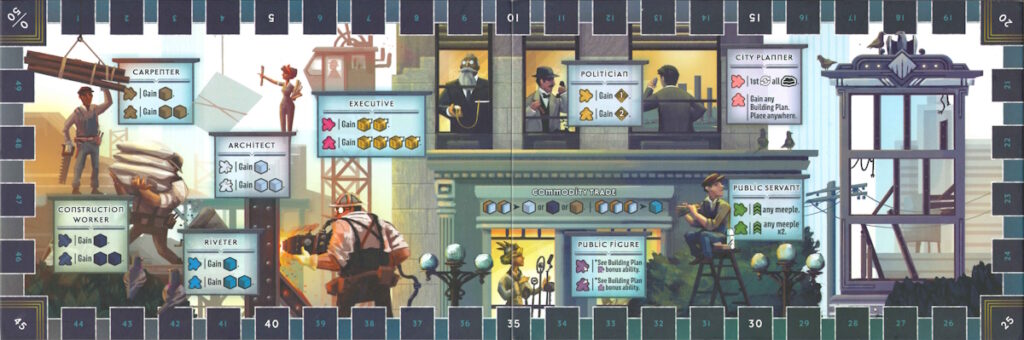
This same dynamic carries over to the score board, where each meeple type is paired with an illustration. Of the 9 people represented, only 2 are women, both svelte. One is an architect, the other appears to be an opera singer cast in the role of public figure. Men hold the construction roles, but also the prestigious ones: city planner, politician, and director (also mayor in solo mode).
This is a familiar narrative. It reflects the position of women in the 1920s, where important roles were reserved for men while women were confined to home related duties such as shopping, caring for children, or entertaining men after a long workday. But is that really the story we want to pass on to future generations? And was it important enough to reproduce in a board game a century later?
The game also lacks ethnic diversity. If the designers wanted to reflect the historical reality of the era, they could have included characters from the various communities that actually built those skyscrapers — including ethnic minorities ironworkers who played a key role in New York's skyline.
The illustrations from the box and the score board are then reused throughout the game. Each new illustration was an opportunity to bring more diversity in gender, ethnicity, and body type. Most of those opportunities were missed.
Accessibility analysis
Physical Accessibility
Setup is not too demanding for a game of this size. The only time-consuming part is counting out the right number of cubes per color based on the player count.
Cardboard containers help keep them contained, so everyone can do their tossing phase at the same time without disturbing the board.
Then come the action phase, and that's where things get harder. Grabbing blueprint tiles is manageable if you're on the right side of the board. But the most important action in the game, building construction plans, requires stacking small cubes on designated spots. It takes a steady hand and good dexterity. It gets even harder when your building is on the far side of the board. The slightest shake can bring everything down. Rebuilding from memory and deduction is the only way to recover from an accident. On BoardGameGeek, some players have even suggested replacing the components with Lego bricks for better stability.
Cleaning up at the end of your turn quicky become a chore. The tile market becomes tedious quickly. You need to align 9 tiles individually along two different tracks, each in their own spot separated by a small gap, making it impossible to slide them all at once.
Watching the city grow as the game progresses is one of Rolling Heights' most satisfying elements. But building is also the game's biggest physical accessibility barrier. The game requires handling a lot of small pieces, and making them bigger is not a practical solution. It would only make the board larger and increase the distances between components. The only real workaround is asking another player to handle the pieces for you when needed. Overall, Rolling Heights is a difficult game for people with physical limitations.

Visual Accessibility
Rolling Heights is a fully open information game, which means a lot of information lives on the board, the tiles, and the score board all at once. That can make things feel busy and easy to lose track of what's yours. The size of the board makes things worse, as information can end up far from where you're sitting. The score board and character reference sheet are well designed, but individual player aids would have been more effective. Having that information within arm's reach would make it easier to read, without having to lean over a growing city or ask someone on the other side of the table to read it out loud.
Finding information specifically on the tiles is even harder. Tiles get buried among buildings as the game progresses, forcing players to lean over or move around the table to see them. The small reminder icons on the sides of the tiles help, but they are too small to be practical. Some icons are easy to mix up, especially building types that can look similar from a distance.
Color plays a key role in Rolling Heights. It distinguishes building materials, action types, and tile ownership. One of the game's graphic designers shared on BoardGameGeek that a full color-blind testing process was carried out. That said, the large number of meeple types makes it hard to avoid colors that are close to one another. Pink and fuchsia, for example, are easy to confuse. Black player tokens can also be difficult to see on the board due to a lack of contrast with the other pieces. Manufacturing variance adds another layer of inconsistency. The final production colors don't always match what was designed on screen, which may explain why some players feel the meeple colors don't quite match the illustrations in the rulebook and on the board.
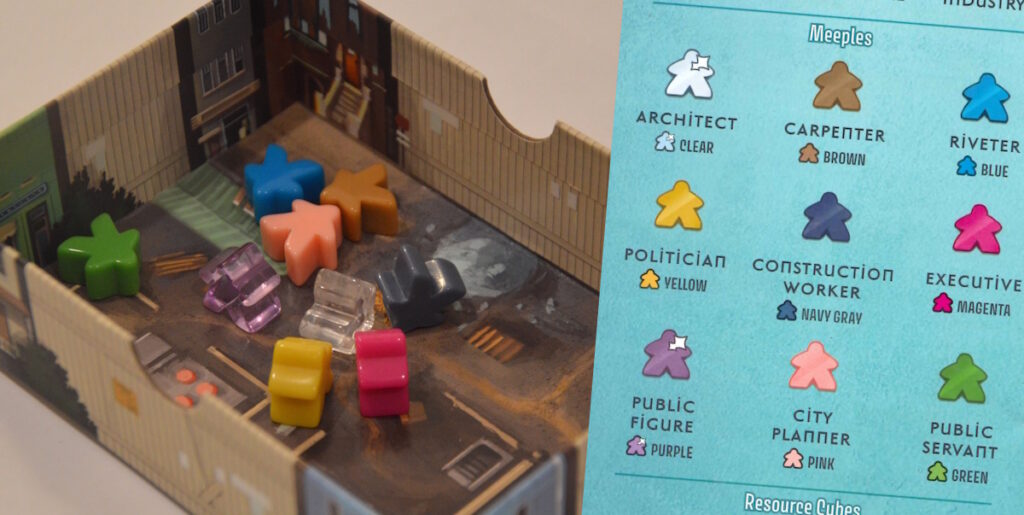
This can have several consequences:
- Unless you pay close attention, it's easy to assign the wrong color to the wrong role and take the wrong actions
- Colors can appear differently depending on the lighting in the room
- Everyone has their own way of naming colors, which creates confusion when asking someone to grab a specific meeple for example. The color names are listed in the rulebook, but it's unlikely players will use the actual worker type names instead. That would require a significant memory effort.
Cognitive Accessibility
Overall, Rolling Heights is simple enough to be an enjoyable family activity, as long as everyone is ready to sit down for at least two to three hours. The flow of the game stays fairly straightforward and dynamic. Complexity and strategic depth build up gradually, giving players time to adjust and get comfortable with the different concepts. New rules that come into play mid-game can still be a lot to take in, especially in your first few plays.
A lot of effort has clearly gone into keeping the game smooth. Most information is translated into icons that are fairly intuitive, visual accessibility aside. The score board serves as a reference for character actions, turn phases, and resource exchange values. Building costs are also printed on the side of tiles so you don't have to look under the cubes. The rulebook also specifies which phases can be played simultaneously to keep things moving.
There is no direct conflict between players. Some objectives may nudge you toward getting in each other's way, but it's always optional. You can occupy construction spots others are aiming for, but no one ever gets truly blocked since spaces can be skipped. Taking the most wanted blueprint tiles from the market is another way to slow others down, though its impact is usually limited. And if needed, the more aggressive objectives can simply be removed and a non-aggression agreement can be set at the start.
The rulebook offers no built-in options to adjust complexity. Games can run long, especially at four players. But a few easy tweaks can help:
- Shorten the game by removing extra cubes of each color at setup.
- Give everyone one or more extra meeples at the start, like a transparent white meeple.
- Reduce complexity by playing with fewer or no shared and personal objectives.
- A fan-made variant that modifies the starting rules has also been shared on BoardGameGeek.
Our biggest complaint on cognitive accessibility remains the absence of individual player aids for meeple actions. The shared reference board gets out of reach quickly, which means either memorizing the actions or getting up every time to check. Some players will probably just take a photo with their phone.
Rulebook
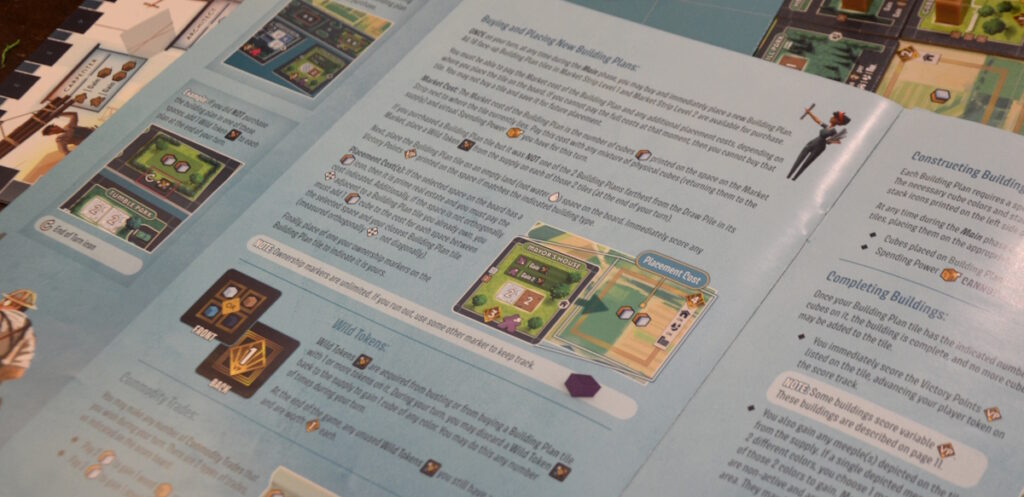
The Rolling Heights rulebook is visually appealing and well written, with a few areas that could be improved.
The format is a bit wide, which makes it awkward to keep on the table during play. That said, information is easy to find. The rulebook makes good use of lists and bolds key terms throughout, which helps with readability and understanding. Icons are referenced directly in the text, making them quick to pick up. Additional explanations in the margins add precision on certain concepts without interrupting the main read.
Typography choices in the rulebook make the text easy to read. The one exception is the secondary headings in light blue on a pale blue background, which would have benefited from more contrast. Worth noting as well: the game's logo font is very hard to read, though we understand that was an intentional aesthetic choice.
Overall, the Rolling Heights rulebook is a solid, clear, and accessible document. Rules are easy to explain out loud by simply following the order of the book.
A few details come up repeatedly in the forums:
- How to use the Public Servant meeple
- Joker tokens
- Several individual and shared objective tiles
- How to use of the orange cubes
These points are not critical to play the game. As long as everyone at the table agrees on the same interpretation, it won't affect the quality of the experience.
Conclusion
Our analysis of Rolling Heights reveals significant issues in gender representation and ethnic diversity. The game components also require several physical abilities, which creates important barriers in terms of physical and visual accessibility.
That said, it is important to recognize the design efforts that went into making the game engaging and fun, through its innovative mechanics and its well-structured, clearly explained rules.
A few specific improvements would have a big impact: better character representation, more distinct colors and textures for visual accessibility, and individual player aids.